
Why Vibe-Coded AI for AV & UC Is Broken
By Erik DeGiorgi
Part 1 of our series on Why quick AI tools, vibe-coded apps, and bolt-on AI features fall short in enterprise AV, UC, and workplace operations.
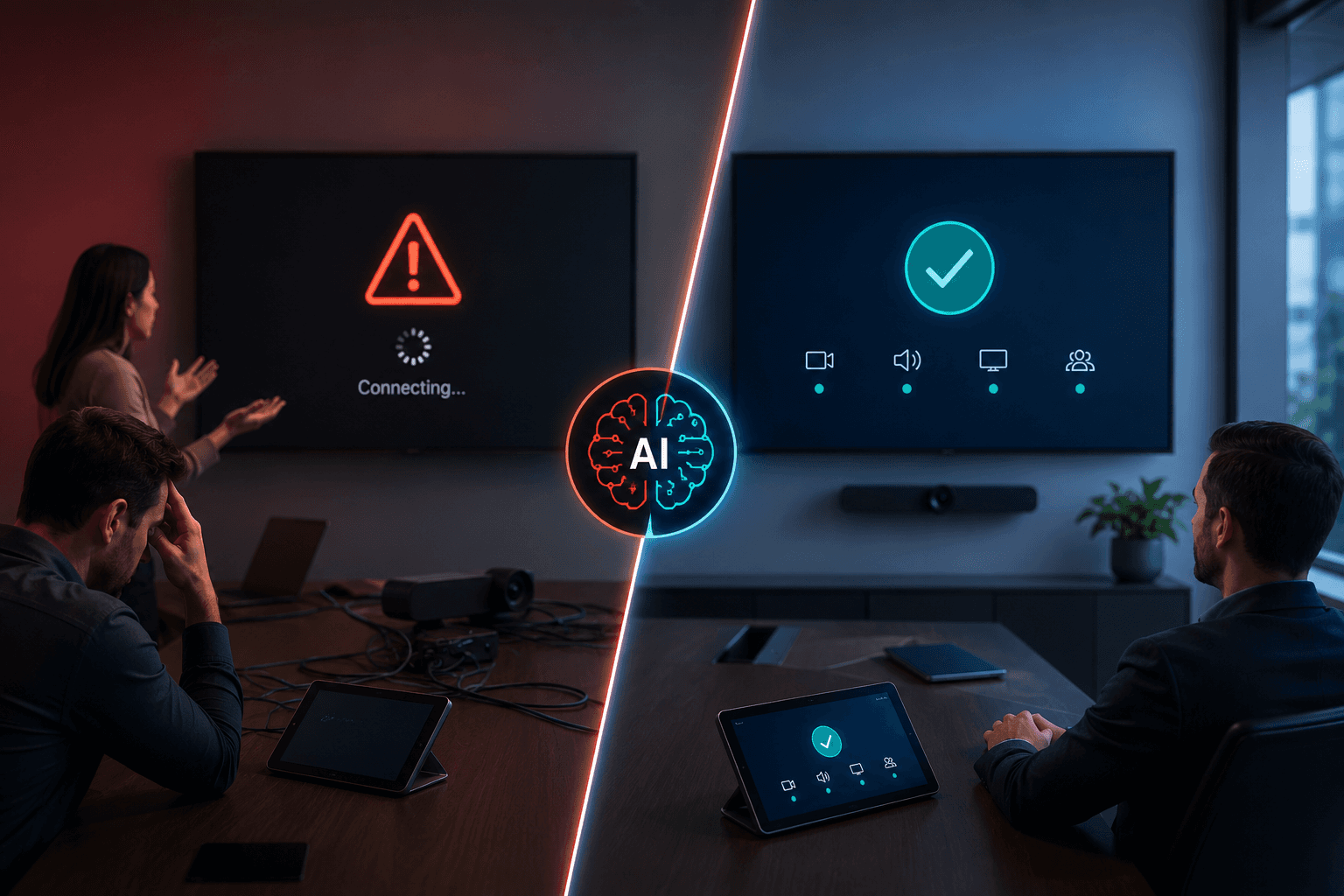
Walk into almost any modern conference room right before a meeting starts and you will recognize the scene. People are seated. The agenda is ready. And the room is not.
Someone is cycling through display inputs. Someone else is on the phone with IT. Everyone else is waiting, checking their phones, doing the quiet math of how much of the meeting they are already losing. The technology in that room is likely more sophisticated than anything that existed a decade ago. It can do more, integrate more, and connect more. But more capable has not translated into more reliable, and it has certainly not translated into easier to operate.
This is the core tension in modern AV and UC environments. The environments have grown dramatically in complexity. The tools used to manage them have not kept pace. And the arrival of AI, for all its promise, has largely made the situation more complicated rather than less.
Smart Workspaces Are Also Complicated Workspaces
Organizations have made significant investments in AV, UC, and workplace technology over the past several years. The result is environments that can deliver genuinely impressive experiences, but only when everything is working correctly. Rooms now depend on multiple vendors, multiple platforms, multiple devices, and multiple integrations. A video call that looks simple from the outside might depend on a codec, a touch panel, multiple cameras, external audio devices, a UC client, a network connection, and a display, all of them in the right state, all of them communicating correctly with each other.
When one element of that chain is wrong, the whole experience breaks. The codec can be online while the display is on the wrong input. The camera can be reachable on the network while the UC platform cannot see it. The audio route can be perfectly functional and completely misconfigured for the meeting that is about to start. Every component can pass a status check while the room fails the only test that actually matters: can the person who just walked in start their meeting?
This complexity is not going away. If anything, the continued investment in hybrid work infrastructure means environments will get more capable, and therefore more intricate, before they get simpler. The organizations that figure out how to operate these environments reliably are going to have a meaningful advantage over those that are still chasing failures reactively.
AI Was Supposed to Make This Easier
When AI started appearing in enterprise technology platforms a few years ago, the pitch was compelling. Faster troubleshooting. Better visibility. Less manual work. Smarter alerts that surface the right information at the right time. For AV and IT teams managing hundreds or thousands of rooms, the idea that AI could reduce the burden of reactive operations was genuinely appealing.
In practice, most AI-powered enterprise tools have not delivered on that promise in any meaningful way. The reason is not that AI does not work. The technology is real, and it is improving rapidly. The reason is that most of these tools were not built to operate AV and UC environments. They were built to sit on top of them and offer commentary.
There is a significant difference between those two things, and the gap between them is where the promise of AI in enterprise AV and UC has mostly stalled.
The Problem with AI as an Add-On
Most enterprise AI in the AV and UC space today is bolted onto existing management systems. The underlying platform was designed for a pre-AI world, built around device connectivity monitoring, alert generation, and dashboard visualization. AI gets layered on top of that foundation as an additional feature, not as a fundamental rethinking of how the platform works.
The result is a system that can look at a narrow slice of data, surface a possible diagnosis, and hand the problem back to a human. It might generate a suggested next step or surface a pattern across recent alerts. But it does not understand the room as a system. It does not retain context about what that specific room has done before, how its configuration has changed over time, or what combination of factors tends to produce failures in that environment. Without that context, the AI is pattern-matching on incomplete information and producing recommendations that a skilled technician still has to interpret, validate, and act on manually.
That is not a meaningful reduction in operational complexity. It is a slightly faster version of what the team was already doing, wrapped in language that makes it sound more sophisticated than it is. And when the AI suggestion is wrong, or when the technician does not have the context to evaluate it quickly, it can actually slow resolution down rather than speeding it up.
Quick scripts, vibe-coded applications, and lightweight add-ons built on top of existing platforms face the same fundamental limitation, often in a more acute form. They are built by people who understand AI tooling but not the operational environment. They can perform well in demos and controlled conditions, and fall apart when they encounter the actual complexity of a real enterprise AV and UC deployment.
What Context Actually Means in AV and UC Operations
The word context gets used a lot in discussions of AI, but it is worth being specific about what it means in an AV and UC environment, because it is doing a lot of work.
Context means knowing the intended configuration of a room, not just its current device status. It means understanding the history of issues in that room and whether the current situation matches a pattern that has appeared before. It means knowing which devices tend to interact in ways that produce failures, and which remediations have worked in similar situations. It means understanding the relationships between systems, not just the status of individual components.
An AI system that lacks this context is like a technician who shows up to fix a room they have never seen before, with no documentation, no history, and no understanding of how the components are supposed to relate to each other. They can try things. They might even get lucky. But they are not operating from understanding. They are guessing with extra steps.
Building an AI system that actually has this context requires a fundamentally different approach to how the platform is designed. It cannot be an add-on. It has to be the foundation.
What Actually Needs to Change
For AI to create real operational value in AV and UC environments, it has to move from the role of assistant to the role of operator. The distinction matters. An assistant surfaces information and makes suggestions. An operator understands the environment, takes action, verifies the result, and learns from the outcome.
That means the AI needs to understand the full environment across devices, rooms, configurations, and integrations. It needs to retain context over time, not just within a single troubleshooting session but across the history of the environment. It needs to connect across systems rather than operating on a narrow data slice. And it needs to take action rather than just making recommendations, executing fixes, confirming results, and feeding what it learns back into its understanding of the environment.
The goal is a system that can tell you what is happening in your environment, help determine why it is happening, take steps to resolve it, and demonstrate that the resolution worked. Not a smarter suggestion box. An operational platform.
The Next Generation Looks Different
The tools that will actually solve the operational complexity problem in enterprise AV and UC will not come from adding a smarter chatbot to an old monitoring dashboard. They will be built differently from the start, with AI as the operating layer rather than a feature sitting on top of a legacy foundation.
AI-native operations platforms see across systems rather than monitoring individual devices in isolation. They understand why things are failing rather than just detecting that they have failed. They take action to resolve issues rather than routing everything back to human operators for manual execution. And they get better over time as they accumulate context about the specific environment they are managing.
Insight is valuable. In complex environments with stretched teams, execution is what changes the outcome. The organizations that will operate the most reliable meeting and collaboration environments in the next few years are the ones that are starting to make that distinction now.
The core problem: Most AI in AV and UC today was built to sit on top of the environment and offer commentary. Operations requires AI that is built to understand, act, and learn from within it.
Next in the series: The Illusion of AI in Enterprise Technology
To learn more or to schedule a demo:
Visit: www.netspeek.com
Contact: lena@netspeek.com
Demo: Book a live walkthrough

Subscribe for Updates
Stay current with the latest from NetSpeek. Learn more about new capabilities, product announcements, technical insights, and thought leadership in AI for AV.
