
The Illusion of AI in Enterprise Technology
By Erik DeGiorgi
Part 2 of our series on why quick AI tools, vibe-coded apps, and bolt-on AI features fall short in enterprise AV, UC, and workplace operations.
AI is everywhere in enterprise technology right now. If you have visited a vendor booth, sat through a product demo, or read a platform release note in the past two years, you have heard the same story: AI-powered insights, AI-driven recommendations, AI-assisted troubleshooting. The language is consistent. The confidence is high. And for most enterprise AV and IT teams, the lived experience has been something quite different.
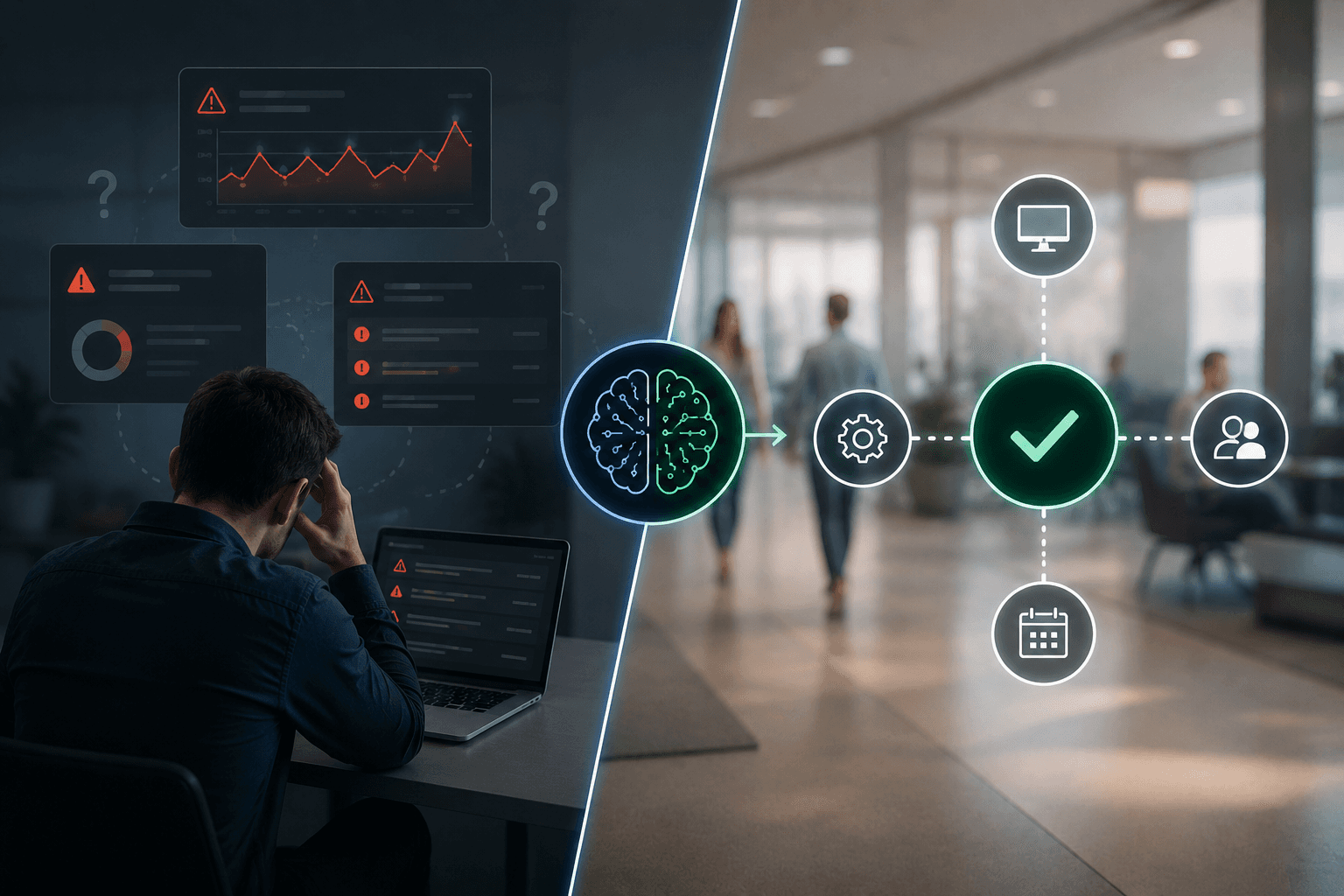
When something actually breaks in a real environment, the routine looks familiar. Investigate the alert. Form a hypothesis. Test it. Wait for the result. Try something else. Repeat until the room is working again or until someone finds the right fix through a combination of experience and educated guessing. The AI platform that promised faster resolution is open in another browser tab, offering suggestions that may or may not apply to the specific situation in front of you.
There is a widening gap between what enterprise AI claims to do and what it actually delivers when it meets a real operational environment. Understanding why that gap exists is the first step toward closing it.
Sounding Smart Versus Being Operationally Useful
A lot of enterprise AI is optimized to sound intelligent. That is not the same thing as being operationally useful, and in AV and UC environments the difference matters enormously.
These tools are genuinely capable of processing large volumes of data, identifying statistical patterns, summarizing alert histories, and generating plausible-sounding recommendations. In a controlled setting, with clean data and a well-defined problem, they can be impressive. The demo works because the demo is designed to work. The data is curated. The scenarios are rehearsed. The edge cases are not invited.
Real enterprise environments are not demos. They are multi-vendor, constantly changing, and shaped by years of accumulated decisions that made sense at the time but are not written down anywhere. When an AI tool trained on general patterns meets a specific room with a specific history and a specific failure mode, the gap between what the tool can say and what it can actually do becomes apparent very quickly.
Saying the right thing and doing the right thing are different capabilities. Most enterprise AI today has been built to do the former and largely cannot do the latter.
The Context Problem
The deeper issue underneath most enterprise AI disappointment is a context problem. The tools do not understand your environment. They understand data about your environment, which is a meaningful distinction.
Understanding your environment means knowing the intended configuration of a specific room, not just its current device status. It means retaining the history of issues in that space, understanding which combinations of factors tend to produce failures, and knowing which remediations have worked before. It means understanding the relationships between systems, the dependencies between devices, and the operational rules that govern how your organization manages its spaces. It means knowing that room 14B on the third floor has a tendency to lose its audio route after certain UC platform updates, and that the fix is specific and repeatable.
Most AI tools see a prompt, a dataset, or a snapshot in time. They process what is in front of them without the accumulated context that makes the difference between a generic recommendation and an actionable one. When a technician with ten years of experience in your environment looks at an alert, they are drawing on a model of the environment that has been built and refined over thousands of hours. When a bolt-on AI tool looks at the same alert, it is pattern-matching on whatever data it has access to, without that depth of environmental understanding.
The result is recommendations that are often directionally reasonable but operationally incomplete. They point roughly toward the right area without providing the specific, contextual guidance that actually gets a room fixed quickly. And the gap between a roughly right suggestion and an actionable resolution is still filled by human effort.
Why This Breaks Down in Practice
The breakdown is predictable once you understand the architecture. An AI add-on that sits on top of an existing monitoring platform inherits all of the limitations of that platform's data model. If the underlying system monitors device connectivity but has no concept of intended configuration, the AI has no way to reason about configuration drift. If the underlying system generates alerts but does not retain resolution history, the AI has no basis for learning which fixes work in which contexts. If the underlying system cannot take action on devices, the AI cannot take action either, no matter how good its recommendations are.
What happens in practice is that human operators end up serving as the integration layer between the AI suggestion and the actual resolution. They read the recommendation. They evaluate whether it makes sense for this specific situation. They execute the fix manually. They verify the result. They close the ticket. The AI has contributed a step in the middle of a process that is still fundamentally manual from end to end.
At that point, the question worth asking is whether the AI step in the middle is actually saving time or adding complexity. In many cases, teams that have evaluated AI-assisted troubleshooting tools honestly will tell you the answer is ambiguous at best. The tool changes where the work shows up. It does not reliably reduce how much work there is.
The Gap Between Insight and Action
This is the operational problem that most enterprise AI leaves unresolved. Some tools have become reasonably capable at the insight side of the equation. They can identify that something is wrong, surface relevant context, and suggest a course of action. That is genuinely better than a raw alert with no analysis attached to it.
But very few systems can do anything about it. The gap between seeing a problem and resolving it is where operational efficiency is actually won or lost, and it is the gap that most AI tools leave entirely intact. A technician still has to read the insight, make a judgment, execute the fix, and confirm the result. The AI has moved the starting line slightly forward. The race is still being run by humans.
In high-volume environments with large room portfolios and stretched teams, that gap has real consequences. Every minute between problem detection and resolution is a minute during which users are affected. Every fix that requires manual execution is a fix that depends on technician availability. Every issue that recurs because its root cause was addressed symptomatically rather than systemically is a ticket that should never have been opened a second time.
The insight-to-action gap is not a minor inefficiency. In a complex enterprise AV and UC environment, it is the difference between an organization that is continuously chasing failures and one that is systematically preventing them.
Moving Beyond the Illusion
Closing the gap requires being clear-eyed about what is actually needed. AI that is genuinely useful in enterprise AV and UC operations needs four things that most current tools do not have.
It needs to understand context across systems, which means the full picture of a room's configuration, history, and environment, not just the current device status. It needs to retain memory over time, building an understanding of the environment that improves with each issue detected and each resolution executed. It needs to integrate deeply with devices and platforms, not sitting on top of them but connected through them in a way that makes action possible. And it needs to execute approved actions, not just recommend them, closing the loop between insight and resolution rather than handing the problem back to a human at the critical moment.
In complex environments, intelligence without action is just another dashboard. The organizations that will operate the most reliable AV and UC environments over the next few years will not be the ones with the most sophisticated alert visualization. They will be the ones with platforms that can detect issues, understand their cause, take action, and learn from the outcome, continuously, at scale, without requiring a proportional increase in the humans doing the work.
That is a meaningfully different kind of tool from what most enterprise AI in this space looks like today. It is not an add-on. It is a different foundation.
The core problem: Most enterprise AI in AV and UC can tell you something is wrong. Very few systems can do anything about it. That gap between insight and action is where operational efficiency is won or lost.
Next in the series: From AI That Talks to AI That Operates
To learn more or to schedule a demo:
Visit: www.netspeek.ai
Contact: lena@netspeek.com
Demo: Book a live walkthrough

Subscribe for Updates
Stay current with the latest from NetSpeek. Learn more about new capabilities, product announcements, technical insights, and thought leadership in AI for AV.
