
The Hidden Cost of Manual Room Checks
By Sam Kennedy
Part 2 of our series Why "It's Online" Isn't Good Enough .
Every morning in enterprise organizations around the world, AV and IT technicians do the same thing. They walk the floor. They check rooms. They reset displays, verify camera inputs, test microphones, and make sure everything is in the right state before the first meetings of the day start. It is time-consuming, it’s repetitive - and unfortunately it’s necessary.
Or it feels necessary, because nobody has built a better alternative at scale.
But manual room checks carry real hard and soft costs that most organizations have never fully considered, and when you do the math, it is hard to ignore.
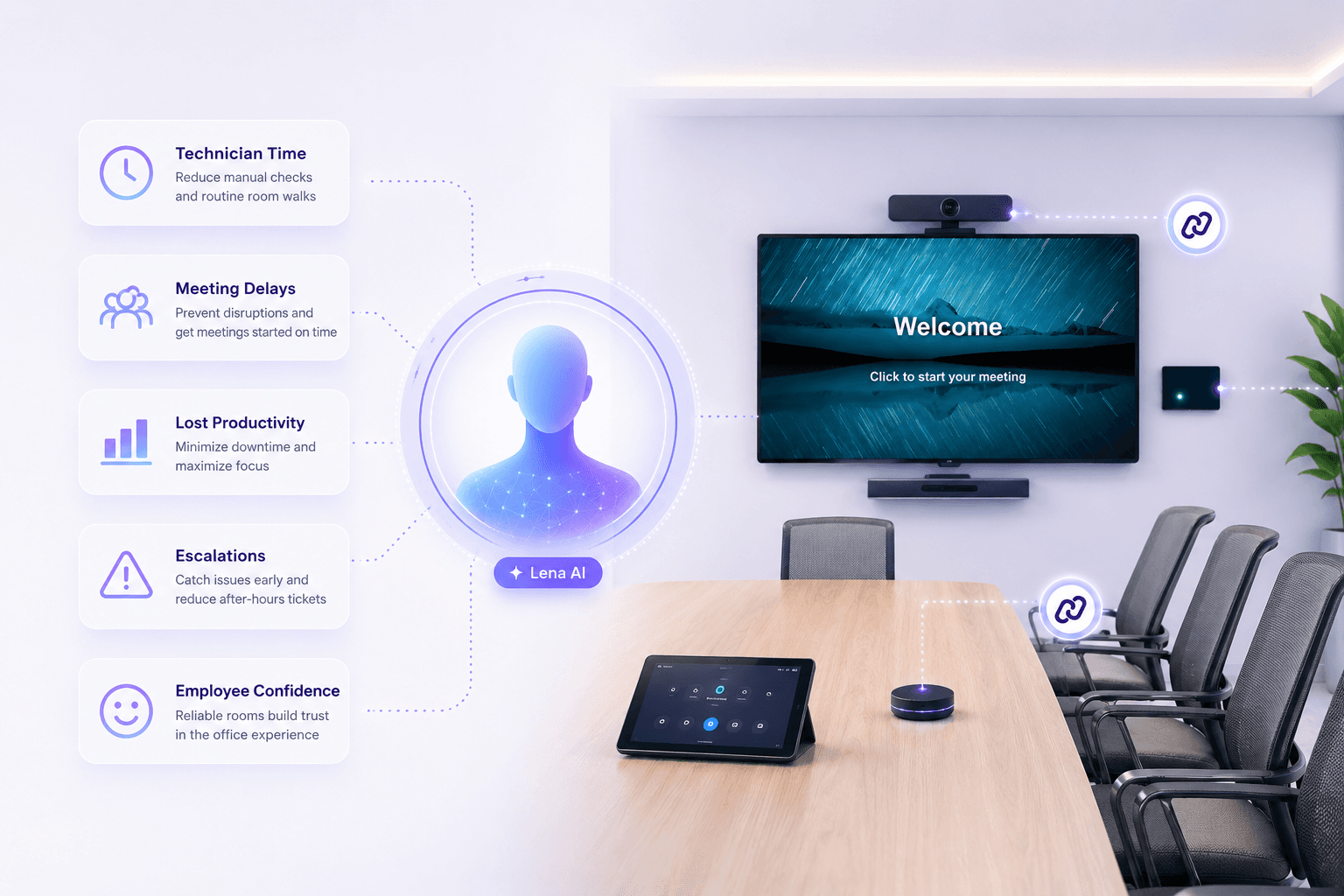
The Visible Cost: Technician Time
The most obvious cost is straightforward. Every room check requires a technician's time. In a small office with 20 rooms, that might be manageable. In an enterprise with hundreds or thousands of conference rooms spread across multiple buildings, floors, cities, or continents, the daily labor cost of manual checks becomes significant. Talented technicians who could be solving complex problems, supporting strategic initiatives, or improving infrastructure are instead walking from room to room performing reboots, and verifying cable connections and display inputs.
And that is just the daily routine. It does not account for the time spent when something goes wrong mid-day and a technician has to respond to a room that was fine at 7am but is broken by 3pm because a previous meeting left it in a bad state.
The Hidden Cost: Meeting Delays and Lost Productivity
The cost that is much harder to see, but ultimately much larger, is the lost productivity when rooms fail and meetings start late. When a conference room is down, it is rarely just one person affected. Enterprise meetings involve multiple people, all of whom are sitting in a room or dialing in from elsewhere, waiting for the technology - everywhere - to work.
We have worked through the math on this. If an enterprise conference room experiences two disruptions per month, and each disruption takes an average of 30 minutes to resolve, that is one hour of downtime per room per month. If a technician at $60 per hour is involved in each resolution, that is $60 in direct labor per room per month. But the real cost comes from the knowledge workers waiting on the other side of that broken room. With an average meeting size of four people at $80 per hour each, each 30-minute disruption costs $160 in lost productivity per incident, or $320 per room per month.
Scale this up to an enterprise with 1,800 conference rooms globally, those numbers add up to more than $8.2 million in annual costs from conference room downtime. That is not a rounding error - that is a meaningful budgetary line item.
The Compounding Cost: Every Failed Meeting Affects Multiple People
What makes this worse is the ripple effect. A meeting that starts 10 minutes late does not just cost 10 minutes. Participants reschedule follow-ups. Decisions get delayed. Morale is impacted. Action items are pushed. For customer-facing meetings or executive presentations, the reputational cost can be even higher. One bad room experience before an important meeting can undermine participant confidence in a way that takes much longer to recover from than the meeting itself.
The Cultural Cost: Employees Lose Confidence in Office Technology
There is a subtler cost that does not show up in any spreadsheet but that anyone who manages workplace technology recognizes immediately. When rooms fail consistently, employees stop trusting them. They start booking backup rooms just in case. They default to their laptops at their desks even when a collaboration space would serve them better. They stop using the technology altogether.
In an era where organizations are investing heavily in return-to-office initiatives and hybrid collaboration infrastructure, the cost of unreliable meeting rooms extends well beyond the individual failed meeting. It undermines the value proposition of the office itself.
The Operational Alternative: Automated Room Readiness
Room Checks inside Lena do not replace your AV and IT team. It gives them leverage. Instead of spending the first hour of every day walking the floor, technicians can see the readiness state of every room in the portfolio from a single view, with issues already identified and, in many cases, already resolved automatically. The rooms that need attention are flagged. The rooms that are ready are confirmed. The team can focus their time and expertise on the situations that genuinely require human judgment.
Automated room checks can catch a meaningful percentage of the issues that would otherwise surface as meeting disruptions. The goal is not to eliminate every possible failure. It is to catch the predictable, detectable issues before users ever encounter them, and to do it at a scale that manual processes simply cannot match.
The calculation: Total room check cost = technician time + user downtime + delayed meetings + escalations + lost confidence. Automated Room Checks in Lena reduce every term in that equation.
Next in the series: Configuration Drift: The Silent Killer of Meeting Room Reliability
To learn more or to schedule a demo:
Visit: www.netspeek.com
Contact: lena@netspeek.com
Demo: Book a live walkthrough

Subscribe for Updates
Stay current with the latest from NetSpeek. Learn more about new capabilities, product announcements, technical insights, and thought leadership in AI for AV.
